Exploring a Client’s Sense of Self in Psychology: A Framework

Key Insights

12 minute read
  • A strong sense of self is built on identity, self-concept, and self-image.
  • Distinguishing these three layers helps practitioners choose more effective interventions.
  • A clear sense of self supports confidence, authenticity, and resilience.

Sense of self in psychologyUnderstanding what clients mean when they say, “I don’t know who I am,” is essential in our work as practitioners.

They may be struggling with their personal identity, a self-construct encompassing roles, core values, and life direction. Clients might be confused about their abilities and what they believe about themselves. Or they might see themselves negatively in the current phase of their life.

In this article, we explore these three dimensions of a continuous and coherent sense of self, how these distinct layers are interlinked, why distinguishing between them matters, and which interventions actually apply at each layer.

Before you continue, we thought you might like to download our five positive psychology tools for free. These engaging, science-based exercises will help you effectively deal with difficult circumstances and give you the tools to improve the resilience of your clients, students, or employees.

What Is the Sense of Self in Psychology?

The sense of self framework refers to the felt experience of being a continuous and coherent person. It enables you to move through the world knowing who you are, what you believe about yourself, and how you show up.

The sense of self in psychology has been broken down into three distinct layers: identity, self-concept, and self-image. These emerge from how you construct yourself throughout your life (Harter, 1999).

Identity is the evolving life story of who you are across your whole life: your values, how your roles matter, and where you belong. It is the meaning-making layer (McAdams & McLean, 2013). Identity is inherently relational. It is formed and reformed through social interactions, cultural context, and personal history (Campbell et al., 1996).

Self-concept refers to the organized set of beliefs you hold about yourself. This includes how you perform in your roles, what you are good at, what is true about you, what you can rely on, and how clearly you can articulate those beliefs (Campbell et al., 1996).

Self-image is how you perceive yourself right now, in this moment. It’s how you think you come across, how you feel about your appearance, and your gut sense of yourself.

Together, they form a therapeutic framework that we as practitioners can use to assess and intervene with precision. As you can see, these three layers are not the same thing, yet they are often used interchangeably.

Confusion or uncertainty arises when one or more layers of the sense of self contradict one another. This misalignment can cause clients to feel like they are different people in different contexts or act in ways that contradict their beliefs about themselves (Schlegel et al., 2009).

For example:

  • Their identity says, “I am a confident leader,” but their self-image in public makes them feel small and invisible.
  • Their self-concept says, “I am good at this,” but their identity no longer aligns with their current abilities.
  • Their identity says, “I am a present parent,” but their self-image says, “I am not doing enough.”

Understanding the distinction between identity, self-concept, and self-image is crucial in this regard because the ease with which clients can articulate who they really are predicts their sense of meaning in life and ability to flourish, and affects their mood and self-esteem (Schlegel et al., 2009).

We as practitioners can help clients understand where the misalignment lies and how to fix it.

Why the Sense of Self Matters

Why a sense of self mattersA sense of self is not an abstract concept. It shapes how we make decisions, how emotionally stable we remain under pressure, and how confident we feel in our abilities (Campbell et al., 1996; Schlegel et al., 2009).

It also determines whether we show up authentically in our relationships and how well we adapt when life changes around us (Lee-Flynn et al., 2011; Rogers, 1959).

When we know who we are, we make decisions based on meaning and purpose rather than external pressure (Schlegel et al., 2009). We navigate transitions with less fear because our sense of self does not depend on momentary feedback (Lee-Flynn et al., 2011).

A coherent sense of self shows up in how we think, feel, relate, and adapt. The sections below break down the five domains where this framework plays out most clearly.

Confidence

People with a stable sense of self have confidence that relies on self-efficacy, which is their belief in their ability to take the actions needed to achieve a specific outcome (Bandura, 1997).

Confident people make mistakes without falling apart because they understand that mistakes don’t define their competence or their self-worth (Lee-Flynn et al., 2011). They are confident because they know themselves well.

Emotional stability

Emotional stability results from a strong sense of self because it provides enough clarity about who you are to understand your emotions and choices in context, rather than being overwhelmed by them (Rogers, 1959; Lee-Flynn et al., 2011).

A strong sense of self produces what Rogers (1959) called congruence, the alignment between who you are and how you experience yourself, which in practice shows up as emotional stability: enough clarity to understand your emotions and choices in context, rather than being overwhelmed by them.

Authenticity

Authenticity implies that you know what you are being true to. When people lack a clear sense of self, they perform versions of themselves they believe others expect. According to Rogers’s (1959) theory of the self, the gap between the real and the performed self generates distress over time.

People who can access their true selves experience their choices as their own and their lives as more meaningful (Schlegel et al., 2009).

Relationships

Relationships are built on a stable self that people can connect with. A person who adjusts who they are depending on whom they’re with leaves others connecting with a performance rather than a person (Campbell et al., 1996).

A clear sense of self makes an honest connection possible because there is a consistent person to know (Rogers, 1959).

Adaptation during change

People with a coherent sense of self navigate change more easily because their story continues even when change strips away familiar roles and routines (McAdams & McLean, 2013). A clear self-concept helps to keep stress levels in check when change occurs (Lee-Flynn et al., 2011).

5 Free Tools

Download 5 Free Positive Psychology Tools

Start thriving today with 5 free tools grounded in the science of positive psychology.

Identity, Self-Concept, and Self-Image: What’s the Difference?

Identity, self-concept, and self-image are not the same and shouldn’t be used interchangeably. Understanding the difference allows you to be more effective in your practice.

In this video, the School of Life summarizes how a lack of sense of self in psychology shows up and provides a set of signals to watch out for.

The Dangers of Missing a Sense of Self - The School of Life

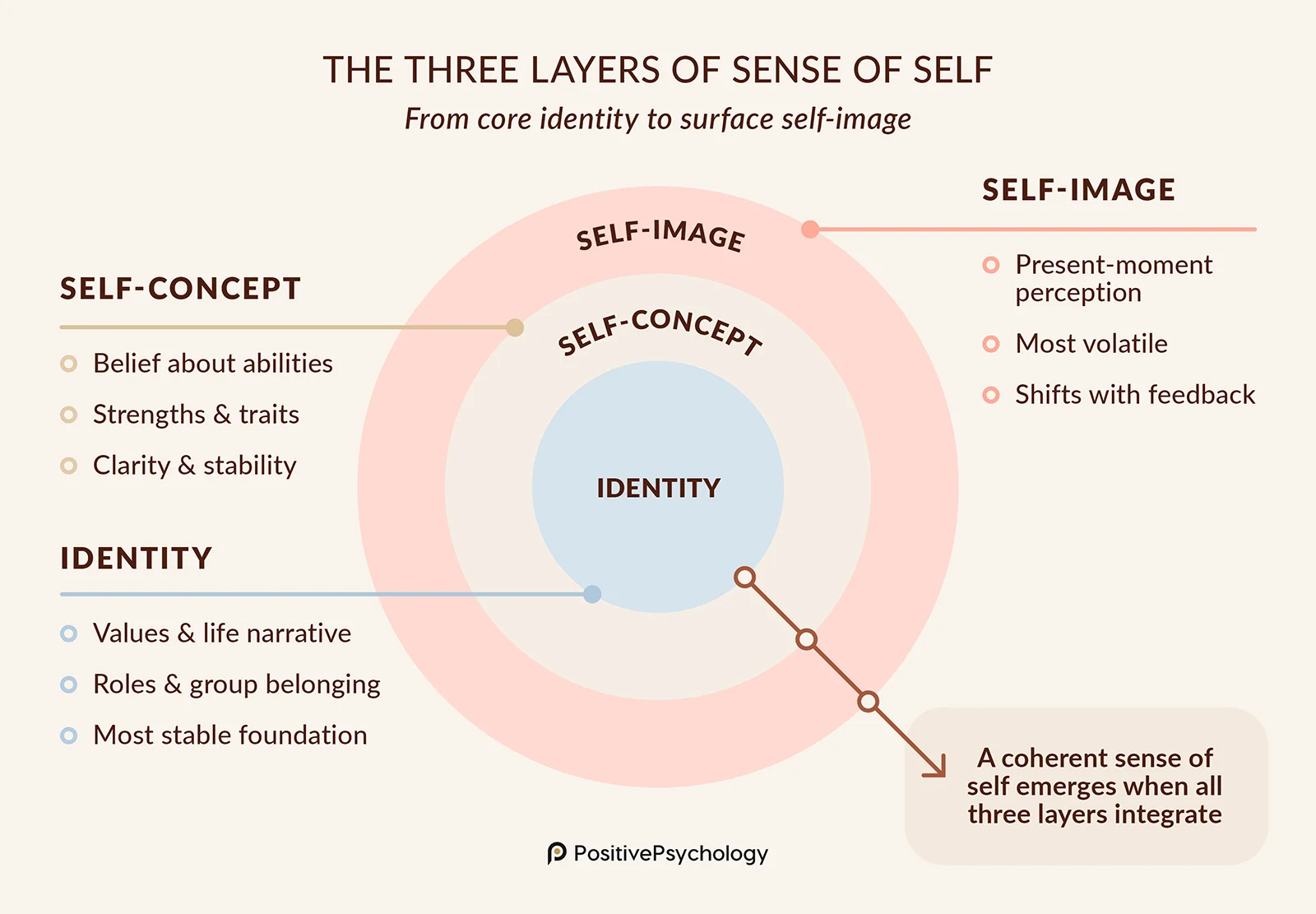
Think of the sense of self framework in three layers. Identity sits at the core: “Who am I fundamentally?” Self-concept sits in the middle: “What do I believe about myself?” Self-image sits at the surface: “How do I see myself right now?”

The three are not interchangeable, and treating them as a single construct is where we as practitioners can make therapeutic assessment mistakes.

Identity Layer: The Foundation of Self

Identity and selfIdentity answers the question, “Who am I across my whole life?” It holds your values, the roles that matter to you, the groups you belong to, and the story you tell about how it all fits together.

Identity is relational and narrative. It is built through connections with others and partly through the ongoing story you tell about your life. Identity development is a lifelong process shaped by social context, key transitions, and the meaning you attach to your experiences (Erikson, 1968; McAdams & McLean, 2013).

You can assess this layer with direct questions such as:

  • Which roles define who you are?
  • What values guide your decisions?
  • What groups and communities do you belong to?
  • What is the story of your life so far? How would you tell it?

Clients who clearly understand their identity can provide a coherent narrative, and their commitments feel chosen rather than imposed. Clients who are confused about who they are may say, “I don’t recognize my life,” and describe roles that feel hollow (McAdams & McLean, 2013).

Use tools like value clarification, narrative and life-story work, and exploration of group and cultural identity when your clients need to focus on gaining greater clarity about their identity layer (Erikson, 1968; McAdams & McLean, 2013).

World’s Largest Positive Psychology Resource

The Positive Psychology Toolkit© is a groundbreaking practitioner resource containing over 600 science-based exercises, activities, interventions, questionnaires, and assessments created by experts using the latest positive psychology research.

Updated monthly. 100% science-based.

“The best positive psychology resource out there!”
— Emiliya Zhivotovskaya, Flourishing Center CEO

Self-Concept Layer: The Cognitive-Emotional Structure

Self-concept is narrower than identity and is formed by what you believe to be true about yourself. It consists of the beliefs you currently hold and would describe consistently across different days and situations.

It has a temporal quality: The self-schemas you carry today may look quite different from those you held as a student and will likely shift again in the future.

Self-concept clarity means you can articulate these beliefs, and they do not contradict each other (Campbell et al., 1996). That clarity is what lets you make decisions without second-guessing them and receive feedback without feeling attacked.

The self-concept layer also encompasses what you hope for, fear, and expect in the future, which shapes your belief in what you perceive to be possible (Markus & Nurius, 1986).

You can assess this layer with direct questions such as:

  • What are you good at?
  • What do you value about yourself?
  • Where are your limits?
  • Who could you become in five years?

A strong self-concept shows up when you can name your strengths without instantly qualifying them and can imagine a future self that feels within reach. A limited self-concept shows up as contradictory self-descriptions and possible selves that are either grandiose or out of reach (Campbell et al., 1996; Markus & Nurius, 1986).

The interventions and tools at this layer include strengths-based exercises, cognitive restructuring of fixed beliefs, and self-efficacy building through small wins (Bandura, 1997; Markus & Nurius, 1986).

Self-Image Layer: The Perceptual Surface

What is self-imageSelf-image, compared to self-concept, is the most fragile layer because it lives in the present moment.

And it also depends more than any other layer on other people, because you form it partly through your perception of how others see you (Sedikides & Gregg, 2003).

Self-image examples include how you think you look right now, how you believe you come across, and the impression you carry into a room (Sedikides & Gregg, 2003). It shifts with context, feedback, and comparison. Compared to identity and self-concept, self-image is most volatile and where other people’s perceptions matter most.

You can assess this self-image with questions such as:

  • How do you see yourself right now?
  • How do you think others see you?
  • What concerns do you have about how you come across?

People with a healthy self-image accept themselves, and minor setbacks do not shake them. People with negative self-image show a persistent gap between competence and felt self-worth, are preoccupied with other people’s perceptions, and are accompanied by a critical inner voice (Neff, 2003).

Working on self-image vs. self-concept with your clients is about how they see themselves, not what they are capable of. Exercises that enable self-compassion practice, reframing distorted perceptions, body image work, and reducing social comparison target this sense of self layer (Neff, 2003; Sedikides & Gregg, 2003).

Here is a short video that summarizes the three different layers of self and how to recognize them.

What If Your Identity Crisis Isn't an Identity Crisis? - Dr. Kinga Mnich

Putting It Into Practice: Assessment Flow

A structured model for therapeutic assessment helps you identify the core issue, because the three layers are so closely related. This ensures that your interventions are precise, efficient, and more likely to create meaningful change.

The therapeutic assessments suggested here are strengths-based. For each layer, we start by exploring what is already clear and working for your client before addressing what has become unclear or misaligned.

The Three Layers of Self

When to explore each layer with your client

Start with self-image when a client has a recent concern that is specific and tied to a current situation, such as a performance review, an uncomfortable meeting, or a comparison that felt uncomfortable.

Self-image is the most accessible starting point because it lives in the present moment. Your clients can usually describe it easily without having to dig deep.

Move to assessing self-concept when your clients’ struggles show up across different areas of life, but still feel largely “in their head.” When your clients are unsure about their strengths (i.e., their abilities and skills), have difficulty naming them without immediately downplaying them, and might contradict themselves from one session to the next, this signals that you are most likely still working within the self-concept space.

Working at this level means that you need to support your clients to bring their beliefs to the forefront so you can explore them together and soften what has turned into “fact” (Campbell et al., 1996).

Explore the area of identity when the disruption is existential rather than situational. When your clients use phrases like, “I don’t know who I am anymore” or “Nothing fits,” you have a clear sign that you are on the right track.

They are questioning roles that previously defined them. Remember that identity work requires more time and narrative space because you are working with the whole life story, not a single belief (McAdams & McLean, 2013).

Use this Sense of Self Assessment & Intervention Matching Guide worksheet to help you analyze and understand which layer of sense of self your client is struggling with, which exercises can be used for each layer, and links to additional reading material to gain a deeper understanding of sense of self.

Sequencing interventions

Once you have identified which layer needs attention, the next question is how to sequence the interventions. When clients are experiencing acute distress, help them to stabilize by starting with self-image work.

Self-compassion practices, inner critic worksheets, and reframing exercises create the space that deeper work requires (Neff, 2003). Move deeper into self-concept once your client is more stable, using strengths-based exercises and possible selves visualization (Markus & Nurius, 1986). Then move toward the identity layer.

Reverse the sequence when you see a lack of integration between the layers and nothing acute is visible. Begin with identity and let self-image stabilize on its own as the deeper layers integrate. Self-image shifts in days, self-concept in weeks, identity in months. If the progress on one layer continues to dissolve, you need to move one layer below (Schlegel et al., 2009).

17 Self-Compassion Tools

17 Exercises To Foster Self-Acceptance and Compassion

Help your clients develop a kinder, more accepting relationship with themselves using these 17 Self-Compassion Exercises [PDF] that promote self-care and self-compassion.

Created by Experts. 100% Science-based.

Case Studies

Let’s look at three cases that focus on each layer individually. These case studies describe people who went through a career transition, change of role, and distorted self-image.

Career transition and identity confusion

Marcus left his academic career for a tech role at 45. He described feeling lost rather than incapable. His core narrative as a researcher no longer worked within the new context.

During therapy, attention should be on the identity layer, where Marcus must focus on integrating his past and his new chapter into one coherent story (McAdams & McLean, 2013).

Negative self-concept

After a merger, Katharina described herself in our coaching session as “performing a role instead of leading.” Her self-concept as “the operations person who gets things done” was no longer fitting the new role.

Katharina built a new narrative that connected her operational past to her future, then clarified which skills and capabilities were transferable and how they aligned with the new role. Her self-image stabilized naturally as the two deeper layers were integrated (Özcan et al., 2025).

Body image and distorted self-image

James was excelling on every level in his professional life, yet he avoided photos and felt physically smaller in meetings. He described it as not being able to take up space in a room because he didn’t want people to look at him.

Self-compassion exercises helped him develop a healthier perception of himself and clearly see and understand his capabilities (Neff, 2003).

A Take-Home Message

Understanding the sense of self in psychology is central to understanding human functioning.

Working with clients on these essential layers is a privilege, and in my experience, one of the most significant and exciting aspects of work occurs here.

Creating a space where clients can explore and align their three layers will make your work more impactful and can enable your clients to create long-lasting change, better self-understanding, and improved self-expression.

When practitioners learn to distinguish identity, self-concept, and self-image, they gain a clearer roadmap for selecting interventions that match clients’ actual difficulties rather than their symptoms.

We hope you enjoyed reading this article. Don’t forget to download our five positive psychology tools for free.

Frequently Asked Questions

The language your clients use will reveal self-image fractures. They may use questions like, “Did I come across OK? Do I look like I belong here? What do they think of me? Am I actually good at this? Can I still do this? Who am I?”

Yes, the three layers of sense of self can conflict with one another, and that’s where the real work happens. Clients can have a clear identity built around independence but a self-concept that still believes they need support. Or, for example, they may hold an identity belief as a present parent while carrying a self-image of someone who is always falling short. When the layers conflict with one another, clients may feel misaligned.

Self-image can shift in days to weeks because it is the most surface-level layer (Neff, 2003). It responds quickly to self-compassion and reframing. Self-concept can take weeks to months to restructure because you are reshaping beliefs that have turned into facts (Campbell et al., 1996).

Identity work takes months and sometimes years, because you are not changing a belief (McAdams & McLean, 2013; Schlegel et al., 2009). Instead, you are helping your client to rewrite the story of a whole life.

  • Bandura, A. (1997). Self-efficacy: The exercise of control. W. H. Freeman.
  • Campbell, J. D., Trapnell, P. D., Heine, S. J., Katz, I. M., Lavallee, L. F., & Lehman, D. R. (1996). Self-concept clarity: Measurement, personality correlates, and cultural boundaries. Journal of Personality and Social Psychology, 70(1), 141–156. https://doi.org/10.1037/0022-3514.70.1.141
  • Erikson, E. H. (1968). Identity: Youth and crisis. W. W. Norton.
  • Harter, S. (1999). The construction of the self: A developmental perspective. Guilford Press.
  • Lee-Flynn, S. C., Pomaki, G., DeLongis, A., Biesanz, J. C., & Puterman, E. (2011). Daily cognitive appraisals, daily affect, and long-term depressive symptoms: The role of self-esteem and self-concept clarity in the stress process. Personality and Social Psychology Bulletin, 37(2), 255–268. https://doi.org/10.1177/0146167210394204
  • Markus, H., & Nurius, P. (1986). Possible selves. American Psychologist, 41(9), 954–969. https://doi.org/10.1037/0003-066X.41.9.954
  • McAdams, D. P., & McLean, K. C. (2013). Narrative identity. Current Directions in Psychological Science, 22(3), 233–238. https://doi.org/10.1177/0963721413475622
  • Neff, K. D. (2003). Self-compassion: An alternative conceptualization of a healthy attitude toward oneself. Self and Identity, 2(2), 85–101. https://doi.org/10.1080/15298860309032
  • Özcan, M., Gündüz Çekmecelioğlu, H., & Konakay, G. (2025). Reflections of self-concept clarity at work: The mediating role of psychological empowerment on the relationship between self-concept clarity and intrinsic motivation. BMC Psychology, 13, Article 470. https://doi.org/10.1186/s40359-025-02800-2
  • Rogers, C. R. (1959). A theory of therapy, personality, and interpersonal relationships, as developed in the client-centered framework. In S. Koch (Ed.), Psychology: A study of a science (Vol. 3, pp. 184–256). McGraw-Hill.
  • Schlegel, R. J., Hicks, J. A., Arndt, J., & King, L. A. (2009). Thine own self: True self-concept accessibility and meaning in life. Journal of Personality and Social Psychology, 96(2), 473–490. https://doi.org/10.1037/a0014060
  • Sedikides, C., & Gregg, A. P. (2003). Portraits of the self. In M. A. Hogg & J. Cooper (Eds.), The Sage handbook of social psychology, (pp. 110–138). Sage.

Let us know your thoughts

Your email address will not be published.

Categories

Read other articles by their category

3 Self-Compassion Tools (PDF)