16 Effective Stress-Management Activities and Worksheets
 With scattered thoughts, sweaty palms, and my heart beating like a drum, I glance at the door and cannot remember anything I prepared.
The interview is in 10 minutes, yet I want to run away.
Sound familiar?
Fear and anxiety lead to stress responses – cognitive, physical, and behavioral.
Deeply embedded and automatic, they evolved to provide humans with warnings, guiding present and future behavior while attempting to maintain a relatively stable internal state known as homeostasis (Brosschot, Verkuil, & Thayer, 2016; Varvogli & Darviri, 2011).
However innate these responses may be, there are ways to manage the stress you perceive.
This article offers our favorite stress-management activities and worksheets to help you deal with whatever challenge lies in your path.
Before you continue, we thought you might like to download our three Stress & Burnout Prevention Exercises (PDF) for free. These science-based exercises will equip you and those you work with, with tools to manage stress better and find a healthier balance in your life.
This Article Contains:
- A Note on Stress-Management Approaches
- Keeping a Digital Stress Diary with Quenza
- Our 3 Favorite Stress-Management Worksheets
- 3 Activities to Help Manage Stress
- Stress Management Within Therapy Sessions
- Worksheets for Your CBT Sessions
- 3 Printable Tools for Children
- Top 3 Exercises for Helping Students
- For Group Therapy Sessions
- A Take-Home Message
- References
A Note on Stress-Management Approaches
Stress, or rather the perception of stressors, can be managed, and there are ways to do so:
- Preparation increases our sense of control and improves confidence.
- Relaxation reduces anxiety and restores focus.
- Maintaining physical health via a healthy lifestyle, balanced diet, and exercise underpins overall mental wellbeing.
Another way to manage stress is to reframe our perception of it.
Rather than see it as unwelcome and to be avoided, pressure can provide an essential opportunity for development and learning. Viewed as an opportunity to thrive, stress can be the motivation to perform at our very best and adopt a growth mindset (Lee, Park, & Hwang, 2016).
In what follows, we will point you toward a range of useful worksheets and tools you can use to help your clients better manage stress. Most are free, but some of these come from our own Positive Psychology Toolkit©, which is a comprehensive subscription-based resource containing more than 400 exercises, activities, interventions, questionnaires, and assessments you can use to support your clients.
If you’re looking for more ways to grow your coaching or therapy practice using engaging, science-backed tools, be sure to check it out.
Keeping a Digital Stress Diary with Quenza
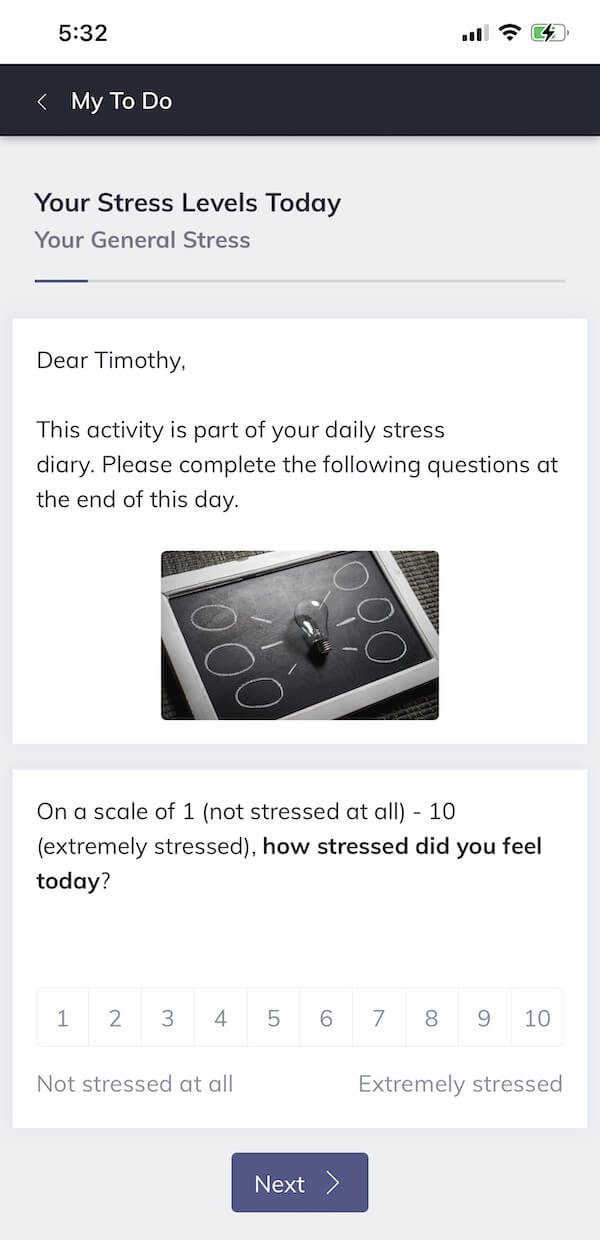 An important first step for getting a handle on stress is to strengthen our awareness of when and how it manifests.
Despite the dangers of experiencing prolonged stress, many of us are likely to be tuned out to our body’s signals that we are experiencing stress.
Likewise, we may not have stopped to consider the factors in our lives that are most responsible for causing us stress.
To help strengthen your clients’ awareness of the drivers and experience of stress, consider inviting them to complete a one-week stress diary.
The purpose of a stress diary is to help them look for patterns and insights into the most common causes of stress in their life and their reactions to stressful events. From here, you can help your clients find effective ways of dealing with stress in the future.
For a great, easy-to-administer tool, consider taking a look at the Stress Diary tool available via the blended care app Quenza.
The platform features a growing library of pre-programmed psychoeducational activities, within which is the Stress Diary Pathway. This pathway invites clients to reflect on the day’s stressful experiences for eight days and culminates in an in-depth reflection into the patterns of stressors, as well as the client’s reactions to these across the eight days.
If you’re interested in learning more, you can try out Quenza’s Stress Diary Pathway for yourself by taking advantage of the platform’s no-risk 30-day trial. These detailed, science-based exercises will equip you or your clients with tools to manage stress better and find a healthier balance in their life.
Download 3 Free Stress & Burnout Prevention Exercises (PDF)
Our 3 Favorite Stress-Management Worksheets
A 2022 report found that in the UK alone, 17 million working days were lost due to stress, depression, and anxiety.
But help is at hand.
Multiple, evidence-based stress reduction techniques have been shown to lower stress levels, “resulting in a reduction of disease symptoms, lowering of biological indicators of disease, prevention of disease and improvement of patient’s quality of life” (Varvogli & Darviri, 2011).
Many of these techniques are described below and will help you to manage stress in your life.
1. Breath Awareness
Breathing exercises can be a powerful way to place your body in a relaxed state. Sitting in a comfortable position and drawing your attention to your breath can release tension and offer a method for ongoing relaxation and a tool to use for times of stress.
Breath Awareness was created to help individuals cultivate a mindful awareness of their breathing and the present moment rather than get caught up in their thoughts.
Once comfortable, clients are asked to release any unnecessary tension and tune in to their breath. They are invited to observe the movements and sensations in their body with each inhale and exhale, without trying to change anything.
The exercise can be useful during moments of distress to unhook someone from their thoughts or as a mindfulness exercise.
Try out the Breath Awareness worksheet and practice it daily.
2. Anchor Breathing
Similar to the last activity, anchor breathing involves inhaling and exhaling consciously while focusing on the physical experience. In this exercise, clients are also instructed to imagine a peaceful scene – being on a boat, feeling calm and safe.
Deep breathing techniques have been shown to lead to decreased oxygen consumption and heightened alertness. EEG recordings have also recorded increases in theta wave amplitude when participants engage in certain deep breathing exercises, which is associated with reduced symptoms of generalized anxiety disorder (Jerath, Edry, Barnes, & Jerath, 2006).
By showing patients how combine mindful breathing with calming, peaceful visualization, Anchor Breathing provides an effective relaxation technique, reducing residual stress levels and providing support during acute episodes of stress (Varvogli & Darviri, 2011).
3. The Five Senses Worksheet
Mindfulness can be cultivated by paying attention to what we observe and feel while using our different senses one at a time. During mindfulness practice, distractions are observed, and attention is gently returned to the body part receiving focus.
This exercise works in a similar way to the Body Scan exercise, which helps clients cultivate a mindful awareness of different body parts. Evidence from functional magnetic resonance imagining found that body scan meditation heightens brain activity linked to increased awareness of the present moment, focus, and stress reduction (Sevinc et al., 2018).
To read more about the steps involved, you can view or download The Five Senses worksheet.
If you’re looking for more tools, our free Mindfulness Exercises Pack includes the popular Leaves on a Stream tool and audio meditation, as well as two other mindfulness tools and audio files that you can download for free.
3 Activities to Help Manage Stress
 We suggest the following three positive psychology activities to help manage stress.
1. Nature effect
The powerful effect of being outdoors has been validated many times and should not be underestimated.
Visitors to a park in Zurich were found to have significantly lower levels of stress, a reduced number of headaches, and a 40% increase in feelings of wellbeing. These positive effects were further elevated in those taking part in sports (Hansmann, Hug, & Seeland, 2007).
While drugs and therapy are often used as treatments for soldiers returning home with post-traumatic stress disorder, the medications and treatment frequently have to be continued for many years without providing a lasting cure. In response, nature-based therapy has begun to receive increased scientific attention.
In a 2016 study, veterans reported that merely being in the garden, often performing mindfulness activities, could improve the symptoms of their post-traumatic stress disorder (Poulsen, Stigsdotter, Djernis, & Sidenius, 2016).
The simple act of getting out into an open space can provide stress relief. We delve deeper into this in our post on Environmental Psychology.
2. Exercise
We are all aware of the physiological rewards of exercise, but the psychological benefits are equally impressive and backed up by research.
A seven-week exercise program was found to improve people’s moods; reduce perceived stress; and increase optimism, self-belief, resilience, and a growth mindset (Cassidy, 2016).
Exercise regimes need not be extreme to be effective. Even modest levels of physical activity if performed regularly provide ongoing support for mental wellbeing, a growth mindset, and reduced levels of stress.
A great way to inspire you to start exercising may be found in our article on Mindful Running and Exercises.
3. Mindful movement
By replacing or combining some of our everyday car journeys with walking, we can become fully present in our day-to-day lives and improve mental health.
Indeed, a trial in 2017 found that combining walking with relaxation techniques is a great way to reduce levels of stress (Matzer, Nagele, Lerch, Vajda, & Fazekas, 2017).
Mindful walking combines the benefits of exercise, nature, and mindfulness.
Its goal is not to reach a destination, but to build an awareness of the moment, using the feet to anchor in the present. Pleasant and unpleasant bodily sensations such as muscle soreness are merely observed without opinion and let go.
3-Minute stress management: reduce stress with this short activity – Therapy in a Nutshell
Stress Management Within Therapy Sessions
Many people seek help when stress makes healthy living difficult. Therapy can help address immediate difficulties and work on the underlying causes (Strauss et al., 2018).
1. Anxiety Record
We often feel more vulnerable when we are asked to share what is making us anxious. The Anxiety Record worksheet helps individuals to understand what is causing their anxiety and learn appropriate coping skills.
Using this worksheet, clients can record their anxieties, triggers, and their effects. Afterward, they are guided through a breathing exercise and asked to revisit their answers to the questions.
A few prompts from this exercise are listed below:
- When do you feel anxious?
- What thoughts are you having before or during feeling anxious?
- Do you think these thoughts are realistic?
- What thoughts could you replace them with?
Click to download the Anxiety Record worksheet and give it a try.
2. Biofeedback training
Biofeedback builds on the concept of homeostasis introduced earlier. Using technology to measure and report brainwaves, skin temperature, breathing, and heart rate, the individual learns how to gain self-control over apparently involuntary bodily functions.
A recent meta-analysis of 24 studies confirmed that biofeedback training led to improvements in coping and offers a promising approach for treating stress and anxiety (Goessl, Curtiss, & Hofmann, 2017).
Individuals can ultimately learn to control their heart rate and blood pressure, reduce levels of stress, and even successfully treat high blood pressure and cardiac disease. Performed with a qualified therapist, these changes ultimately persist beyond the therapy (Varvogli & Darviri, 2011).
Worksheet Suggestions for Your CBT Sessions
 The following two activities can be converted into actionable worksheets for your therapy sessions.
1. Imagery
Many of us experience spontaneous thoughts as images rather than individual words or an internal conversation (Beck & Beck, 2011).
A child pictures an angry parent, and an employee imagines a demanding boss. They can be powerful, representing moments of fear or anxiety, and can be used in Cognitive-Behavioral Therapy (CBT) sessions.
The following questions can form the basis of a conversation to explore a mental image and the individual’s relationship with it, cognitively restructuring its interpretation.
| Consider the mental image |
|---|
| Did you imagine what your boss might look like when you asked about the promotion? |
| Can you imagine him now? What would he look like? |
| How are you feeling? |
| Can you see how you stopped at the worst image? |
| Can you picture what happens next? And then? |
| Do you feel better in the new image than before? |
| Let’s review from stopping at the worst image through to completion. |
Imagery can feel as real to the mind as being in the situation, so playing through images in advance can restructure thoughts and emotions and reframe the stress.
2. Daily Exceptions Journal
A journal can be a fruitful way to track life’s ups and downs. Positive CBT encourages monitoring the client’s strengths and the positive outcomes of life rather than focusing on the negatives.
By capturing what went well in a Daily Exceptions Journal, it is possible to identify and record the skills and talents for reuse in other areas of your life.
Subsequently, walking through the journal during therapy reinforces successes, provides praise, and encourages discussion of the problems overcome.
3 Printable Tools for Children
Sensory awareness involves paying attention to a specific sensory aspect of the body. It can be a great way to teach mindfulness to children.
Such activities can also improve focus, increase self-awareness, help regulate emotions, and reduce anxiety.
1. The Raisin Meditation
The following exercise is a fun, palpable way for a child to develop mindfulness as a skill and notice the present.
Work through the Raisin Meditation worksheet following the steps with the child, paying attention to each sense in turn.
Children paying increased attention to their senses can learn to improve their focus and feel calmer.
2. Nature Play
Ongoing research has recognized the importance of playing and spending time outdoors on children’s mental wellbeing (Dankiw, Tsiros, Baldock, & Kumar, 2020).
Practicing underused senses such as sound can heighten a sense of awareness and promote mindfulness. This can be especially true in an unfamiliar environment, including walking through the countryside with family.
| Step | Sounds |
|---|---|
| 1 | Pause and listen |
| 2 | What can you hear that is nearby? |
| 3 | What can you hear that is far away? |
| 4 | What is the loudest sound? |
| 5 | What is the quietest sound? |
| 6 | Can you walk without making a noise? |
The questions can be tailored to the environment. Starting or pausing somewhere relatively quiet may assist the child’s focus more at the start.
Print the Nature Play worksheet here.
3. Anchor Breathing
Anchor breathing can be quickly learned and helps a child to focus their mind on one point.
Such mental training offers a valuable method for gaining perceived self-control and reducing stress.
| Step | Sounds |
|---|---|
| 1 | Imagine being on a boat, feeling calm and safe. |
| 2 | Attached to the boat is an anchor. It keeps you there, where you want to be, and happy. |
| 3 | Our bodies, like the boat, also have anchors, and they can help us focus. Our belly, our nose and mouth, and our chest and lungs can help us feel grounded. |
| 4 | With your hands on your chest, breathe in deeply. |
| 5 | Breathe out slowly. |
| 6 | Feel your ribs rise and fall. |
| 7 | As your mind wanders, gently bring it back to the anchor point. |
The Anchor Breathing method also works with hands placed gently on the belly or in front of the nose.
Top 3 Exercises for Helping Students
 Research published in 2013 reported that a seven-week mindfulness-based stress reduction training course given to medicine and psychology students resulted in significant improvements in both mental distress and study stress (de Vibe et al., 2013).
The following three examples, along with the activities described above, can be learned quickly and implemented into a student’s daily routine to help manage both acute and chronic stress.
1. Urge Surfing
Coping with (often self-destructive) urges can be difficult, especially in times of stress. Such behavior can become a crutch, making us feel like we are taking control, when in reality, we are relinquishing it.
The Urge Surfing worksheet is available with a subscription to the Positive Psychology Toolkit©. Backed up by scientific research, mindful self-acceptance can teach individuals to observe their cravings rather than act upon them.
2. Meditation on the Soles of the Feet
Meditation on the Soles of the Feet provides a safe space to work on managing strong emotions and regulating the urge to be aggressive, often a byproduct of stressful situations (Kruk, Halász, Meelis, & Haller, 2004).
The individual is not asked to stop angry thoughts – anger does serve a useful purpose at times – but rather to bring them under control through a shift of focus.
The client, standing or sitting with their feet on the ground, is asked to cast their mind back to a time that caused them to react very angrily. Then they are told to stick with those angry thoughts, letting them flow without hindrance. After that, they shift their attention to the soles of their feet.
Stretching and moving their toes, they feel the texture of their socks, the surface of the ground, or the insole in their shoes. They maintain focus, breathing naturally until feeling calm and in control.
Learning to manage anger more effectively reduces stress and anxiety, and increases feelings of control.
The full exercise is accessible with a subscription to the Positive Psychology Toolkit©.
3. Mindfulness
Working through the Leaves on a Stream and anchor breathing techniques, which are part of our free Mindfulness Exercises Pack, will help students focus awareness on the present moment and acknowledge and accept their feelings, thoughts, and emotions.
For Group Therapy Sessions
Research has identified the benefits of combining mindfulness and group therapy to help manage stress and increase resilience and positivity (Seyyed Moharrami, Pashib, Tatari, & Mohammadi; Babakhani, 2017).
Here is an example of a group exercise in mindfulness.
Walking Down the Street
The ability to observe, rather than react to, thoughts, emotions, and sensations is central to positive psychology.
The challenge is that the event and our thoughts about it are far from being the same.
The steps involved in the following exercise can be performed individually or in a group exercise, where everyone benefits from hearing one another’s thoughts.
| Step | Ask the group to: |
|---|---|
| 1 | Vividly imagine walking down a street and seeing someone they know well. They like the person and are happy to see them. |
| 2 | Make the image as real as possible: sights, sounds, smells, and bodily sensations. Become aware of and discuss associated thoughts and emotions. |
| 3 | Picture saying hello, while waving. |
| 4 | Imagine that your friend, rather than acknowledging you, walks by without a hint of recognition. |
| 5 | Consider how this makes you feel. Become aware of the thoughts that go through your mind. |
Walking through the scene and discussing it in the group can help to develop positive behavioral change by separating thoughts and feelings from impulses and actions and, importantly, shape feelings while breaking a negative cycle of thinking.
The full exercise is accessible with a subscription to the Positive Psychology Toolkit©.
17 Exercises To Reduce Stress & Burnout
Help your clients prevent burnout, handle stressors, and achieve a healthy, sustainable work-life balance with these 17 Stress & Burnout Prevention Exercises [PDF].
Created by Experts. 100% Science-based.
Resources from PositivePsychology.com
Building resilience helps clients bounce back from stressful situations and use coping mechanisms to turn them into opportunities for growth.
The Realizing Resilience Masterclass© provides guidance, along with a set of practical tools, to build a more resilient mindset.
If you’re looking for more science-based ways to help others manage stress without spending hours on research and session prep, this collection contains 17 validated stress management tools for practitioners. Use them to help others identify signs of burnout and create more balance in their lives.
A Take-Home Message
Stress does not have to rule us. Stress should not be allowed to prevent us from doing what we want or need to do.
Instead, stress should be an enabler and drive us forward to build what we want and take on challenges that will allow us to grow.
There should be no excuse to hide from stress or become overwhelmed by it.
By using tools for coping and taking control, we can see stress as something natural that can invigorate and motivate us to overcome both planned and unexpected challenges.
These activities we shared will definitely help you manage stress. However, there are many other stress-management techniques to try out too. Identify those that work for you and implement them into your life. You will reap the benefits, especially before the next job interview or presentation.
Thank you for reading!
We hope you enjoyed reading this article. Don’t forget to download our three Stress & Burnout Prevention Exercises (PDF) for free.
- Arch, J. J., & Mitchell, J. L. (2015). An Acceptance and Commitment Therapy (ACT) group intervention for cancer survivors experiencing anxiety at re-entry. Psycho-Oncology, 25(5), 610–615.
- Beck, J., & Beck, A. (2011). Cognitive behavior therapy: Basics and beyond. Guilford Press.
- Bergstrom, C. (2018). Ultimate mindfulness activity book: 150 mindfulness activities for kids and teens (and grown-ups too!). Blissful Kids.
- Babakhani, K. (2017). The effectiveness of cognitive-behavioral therapy group on self-efficacy and quality of life of women with breast cancer. Multidisciplinary Cancer Investigation, 1(1).
- Brosschot, J. F., Verkuil, B., & Thayer, J. F. (2016). The default response to uncertainty and the importance of perceived safety in anxiety and stress: An evolution-theoretical perspective. Journal of Anxiety Disorders, 41, 22–34.
- Cassidy, T. (2016). Psychological benefits of adhering to a programme of aerobic exercise. Clinical and Experimental Psychology, 2(2).
- Dankiw, K. A., Tsiros, M. D., Baldock, K. L., & Kumar, S. (2020). The impacts of unstructured nature play on health in early childhood development: A systematic review. PLoS One, 15(2).
- De Vibe, M., Solhaug, I., Tyssen, R., Friborg, O., Rosenvinge, J. H., Sørlie, T., & Bjørndal, A. (2013). Mindfulness training for stress management: A randomized controlled study of medical and psychology students. BMC Medical Education, 13(107).
- Goessl, V. C., Curtiss, J. E., & Hofmann, S. G. (2017). The effect of heart rate variability biofeedback training on stress and anxiety: A meta-analysis. Psychological Medicine, 47(15), 2578–2586.
- Hansmann, R., Hug, S., & Seeland, K. (2007). Restoration and stress relief through physical activities in forests and parks. Urban Forestry & Urban Greening, 6(4), 213–225.
- Jerath, R., Edry, J. W., Barnes, V. A., & Jerath V. (2006). Physiology of long pranayamic breathing: Neural respiratory elements may provide a mechanism that explains how slow deep breathing shifts the autonomic nervous system. Medical Hypotheses, 67(3), 566–571.
- Kruk, M. R., Halász, J., Meelis, W., & Haller, J. (2004). Fast positive feedback between the adrenocortical stress response and a brain mechanism involved in aggressive behavior. Behavioral Neuroscience, 118(5), 1062–1070.
- Lee, C. S., Park, S. U., & Hwang, Y. K. (2016). The structural relationship between mother’s parenting stress and child’s wellbeing: The mediating effects of mother’s growth mindset and hope. Indian Journal of Science and Technology, 9(36).
- Matzer, F., Nagele, E., Lerch, N., Vajda, C., & Fazekas, C. (2017). Combining walking and relaxation for stress reduction: A randomized cross-over trial in healthy adults. Stress and Health, 34(2), 266–27.
- Poulsen, D. V., Stigsdotter, U. K., Djernis, D., & Sidenius, U. (2016). ‘Everything just seems much more right in nature’: How veterans with post-traumatic stress disorder experience nature-based activities in a forest therapy garden. Health Psychology Open, 3(1).
- Sevinc, G., Hölzel, B. K., Hashmi, J., Greenberg, J., McCallister, A., Treadway, M., … Lazar, S. W. (2018). Common and dissociable neural activity after mindfulness-based stress reduction and relaxation response programs. Psychosomatic Medicine, 80(5), 439–451.
- Seyyed Moharrami, I., Pashib, M., Tatari, M., & Mohammadi, S. (2017). The efficiency of stress management group therapy in job stress and self-efficacy of nurses. Journal of Torbat Heydariyeh University of Medical Sciences, 5(1), 42–49
- Strauss, C., Gu, J., Pitman, N., Chapman, C., Kuyken, W., & Whittington, A. (2018). Evaluation of mindfulness-based cognitive therapy for life and a cognitive behavioral therapy stress-management workshop to improve healthcare staff stress: Study protocol for two randomized controlled trials. Trials, 19(209).
- Varvogli, L. & Darviri, C. (2011). Stress management techniques: Evidence-based procedures that reduce stress and promote health. Health Science Journal, 5, 74–89.

Let us know your thoughts
Related articles



Read other articles by their category
- Body & Brain (49)
- Coaching & Application (57)
- Compassion (26)
- Counseling (51)
- Emotional Intelligence (24)
- Gratitude (18)
- Grief & Bereavement (21)
- Happiness & SWB (40)
- Meaning & Values (26)
- Meditation (20)
- Mindfulness (45)
- Motivation & Goals (45)
- Optimism & Mindset (34)
- Positive CBT (28)
- Positive Communication (20)
- Positive Education (47)
- Positive Emotions (32)
- Positive Leadership (18)
- Positive Parenting (4)
- Positive Psychology (33)
- Positive Workplace (37)
- Productivity (17)
- Relationships (46)
- Resilience & Coping (36)
- Self Awareness (21)
- Self Esteem (38)
- Strengths & Virtues (32)
- Stress & Burnout Prevention (34)
- Theory & Books (46)
- Therapy Exercises (37)
- Types of Therapy (64)
What our readers think
The resources was very helpful. thanks.
Interesting article although I wasn‘t able to open the links as it sent me to a site saying I had to purchase a toolkit in order to access them! I don‘t know why I get sent emails with resources that I‘m unable to access. Shame!
Hi Tansy,
Glad you found the article interesting, and I’m sorry our distinction between the free and paid resources here is not as clear as it could be — I’ll flag this with our editor. Yes, some of the resources listed are freely available while others are available to subscribers of the Positive Psychology Toolkit. However, the three resilience exercises mentioned at the beginning are free and should instantly arrive in your inbox and be available to use.
– Nicole | Community Manager
These will be most helpful with the Native American population I serve
Very practical exercises of relaxation. True we have to rule ourselves not left to unnecessary stress which consequently results in low well being and reduce quality of life. Thank you Jeremy
Very helpful and easy to understand and practice documents. Grateful.
The article was more helpful and am looking forward to read more of this kind.
Hi Moses,
So glad you found the resources helpful. Another great tool for dealing with stress is journaling, which you can read up about in our dedicated article here.
– Nicole | Community Manager